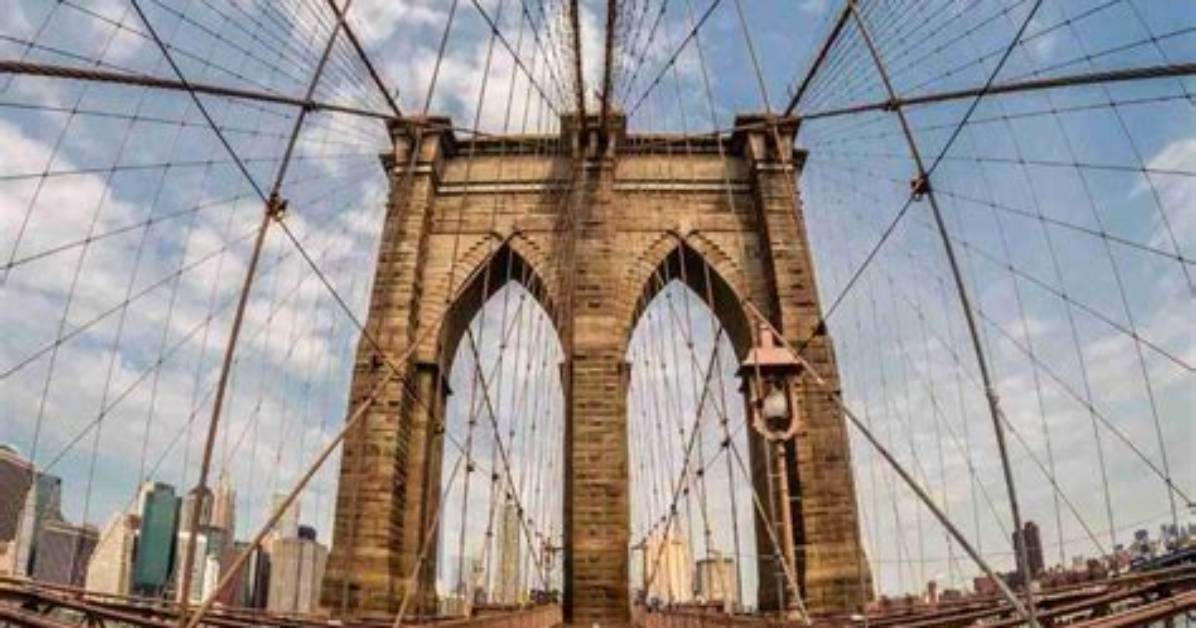
While suspension spans dominated wide bays, moving industrial freight demanded extreme structural rigidity. Suspension bridges are notoriously flexible; long freight trains entering a flexible suspension deck cause localized deflections that can derail railcars. This operational bottleneck highlighted the value of deep steel arches and the cantilever bridge.
Australia’s Sydney Harbour Bridge, opened in 1932 under the engineering direction of J.J.C. Bradfield and Ralph Freeman, resolved this challenge on an unprecedented scale. Nicknamed "The Coathanger," the span carries eight roadway lanes, two rail tracks, a pedestrian path, and a cycleway. Instead of using delicate suspension hangers, Bradfield selected a two-hinged riveted steel through arch spanning 1,654 feet.
To erect the arch without interrupting marine navigation, engineers built the two halves out from each shore as temporary cantilevered arms, anchoring them into deep rock tunnels via 128 high-tensile steel cables. When the two halves met in August 1930, workers gently lowered the arms together using hydraulic jacks. The resulting arch possessed immense structural integrity, providing the deadweight mass and stiffness required to absorb simultaneous freight train braking loads. Scotland's Forth Bridge (1890) proved the cantilever's industrial merit, but Sydney proved that a massive steel arch could carry unprecedented multimodal freight directly into a metropolitan core.