
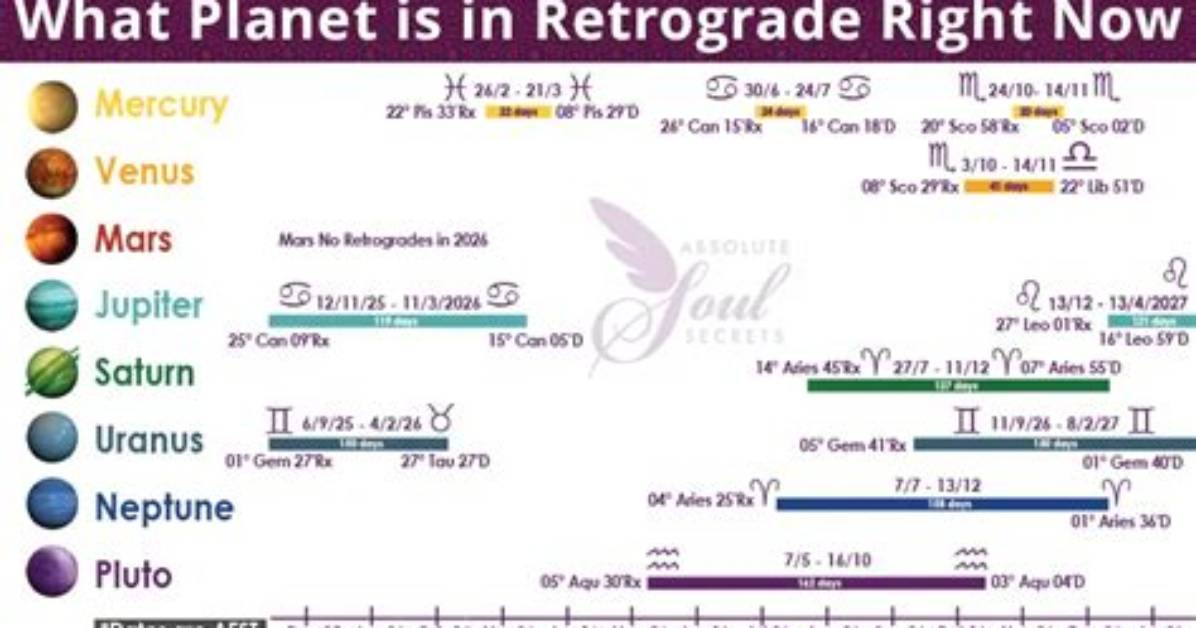
Planets do not stop, reverse gears, or spin backward in their orbits. Every planet in our solar system moves continuously counterclockwise along an elliptical path around the Sun. What skywatchers observe as backward motion is known in astrophysics as apparent retrograde motion.
This visual quirk behaves exactly like driving past a slower flatbed truck on an interstate highway. When your car pulls alongside the truck and accelerates ahead, the truck appears to drift backward against the distant tree line, even though both vehicles are moving forward at high speeds.
| Orbital Classification | Planets Included | Retrograde Frequency | Physical Cause of Visual Reversal |
|---|---|---|---|
| Inferior Planets | Mercury, Venus | Mercury: 3, 4 times/year; Venus: Every 19 months | Faster internal orbits lap Earth on the inside track |
| Superior Planets | Mars, Jupiter, Saturn | Mars: Every 26 months; Gas Giants: Annually (4, 5 months) | Earth overtakes their slower, wider orbits from the inside |
| Ice Giants & Outer Bodies | Uranus, Neptune, Pluto | Annual cycles lasting 5, 6 months per year | Long orbital periods make apparent motion reverse for nearly half of Earth's year |
For planets orbiting interior to Earth, namely Mercury and Venus, the geometry works in reverse. Mercury whips around the Sun in just 88 Earth days at an average velocity of 47 kilometers per second. As Mercury sweeps between Earth and the Sun during inferior conjunction, it laps Earth from behind. From our terrestrial vantage point, its line of sight against the fixed constellations temporarily loops back on itself before straightening out.


