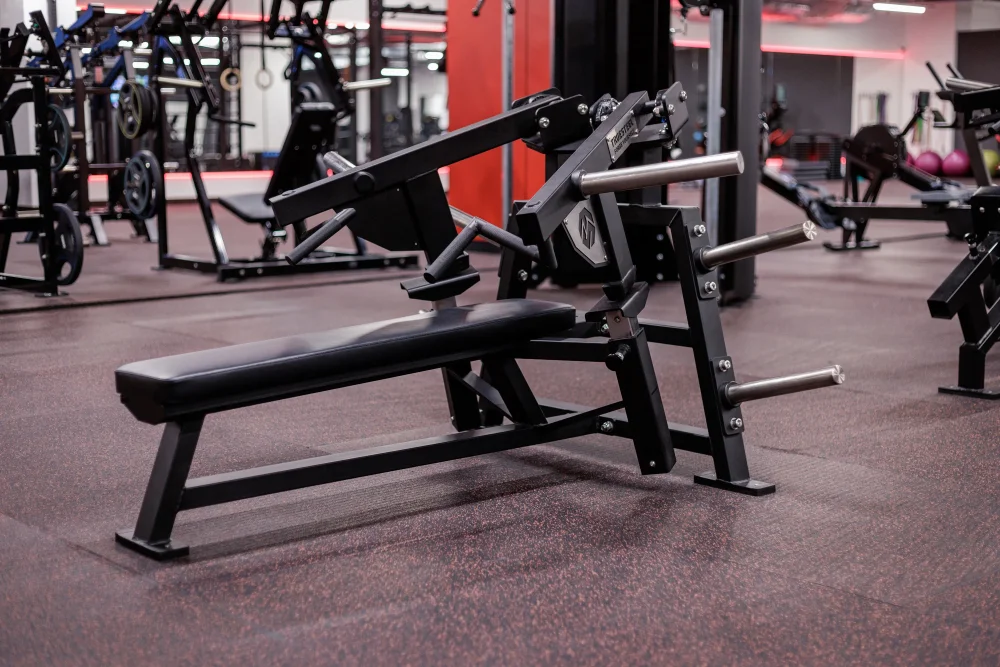
Choosing the right pressing movement depends on your specific training priorities, anthropometry, and current injury status. The table below outlines how modern machine pressing contrasts with traditional barbell and dumbbell methods.
| Exercise Variation | Primary Loading Axis | Stability Requirement | Failure Proximity Risk | Joint Profile |
|---|---|---|---|---|
| Flat Barbell Bench | Vertical (Gravity-dependent) | High (Three planes of balance) | High (Requires spotter/safeties) | Rigid; high shoulder/wrist torque |
| Flat Dumbbell Bench | Vertical (Variable converging) | Very High (Unilateral balance) | Moderate (Dumbbells can be dropped) | Accommodating; natural wrist rotation |
| Plate-Loaded Press | Fixed / Converging Lever Arc | Low (Guided path) | Negligible (Built-in bottom stops) | Joint-friendly pressing; ergonomic |
| Selectorized Machine | Cam-Guided Constant Cable Tension | Very Low (Fully isolated track) | None (Instant pin release) | Very gentle on connective tissue |