
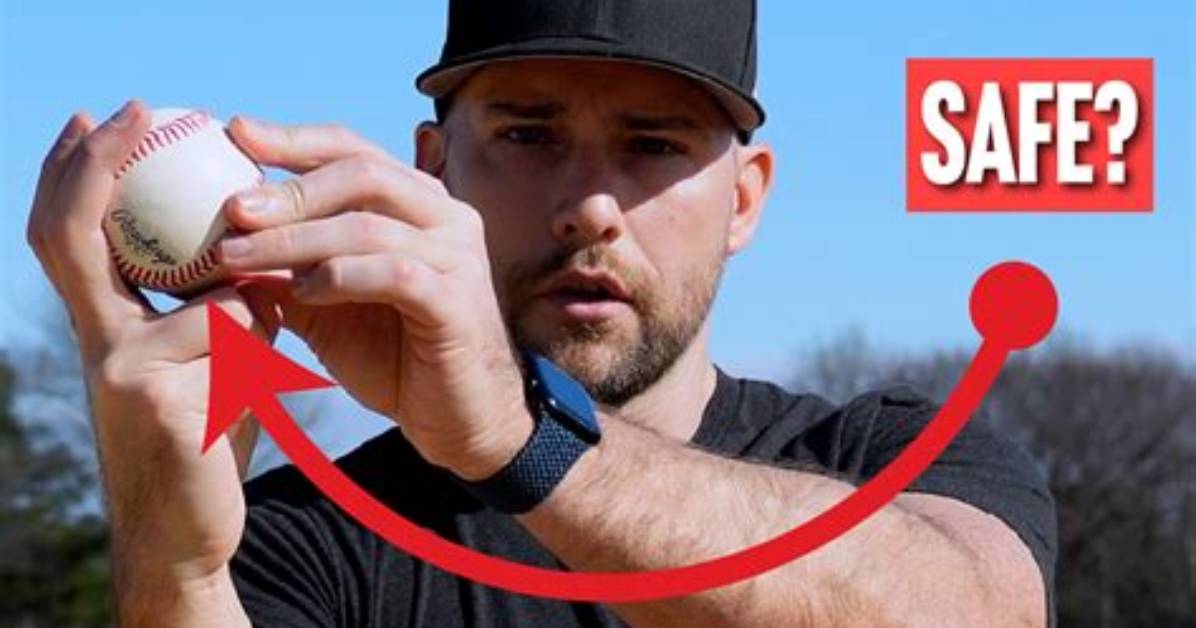
Effective curveball grip mechanics rely on asymmetrical friction. Because baseball seams are raised by roughly 0.03 inches, orienting the leather properly dictates the ultimate spin axis and spin rate.
The heavy lifting belongs exclusively to the middle finger. Pitchers orient the ball along the horseshoe seam orientation, resting the pad of the middle finger against the leather ridge. The index finger provides virtually zero forward propulsion on a standard breaking ball. In fact, many modern pitching coaches advocate lifting the index finger entirely or pressing the fingernail into the leather, a variation known as the spike curveball.
Spiking the index finger achieves two distinct mechanical goals:
- It removes opposing downward friction from the index finger, allowing the middle finger to apply 100% of the directional force along the targeted seam.
- It prevents premature wrist pronation, keeping the forearm in its natural supinated alignment until the ball clears the hand.
Directly beneath the ball sits the stabilizer: the thumb. Pitchers who struggle with erratic command often fail to manage thumb placement under the ball. If the thumb creeps up the side of the ball, it creates counter-rotation that turns a sharp 12-to-6 curveball into a flat, hittable slurve. Modern pitch designers teach pitchers to place the thumbnail or bone directly on the bottom seam, acting as a secure shelf until the middle finger pulls through.


